True Tales
Saturday, August 2, 2014


Sunday, March 9, 2014
VISITANT at Project Arts Centre, Dublin. 19-22 February 2014
Visitant
Directed by Trevor Knight
Choreography Gyohei Zaitsu
Performers Gyohei Zaitsu, Trevor Knight and Aine O’Dwyer
Music Trevor Knight and Aine O’Dwyer
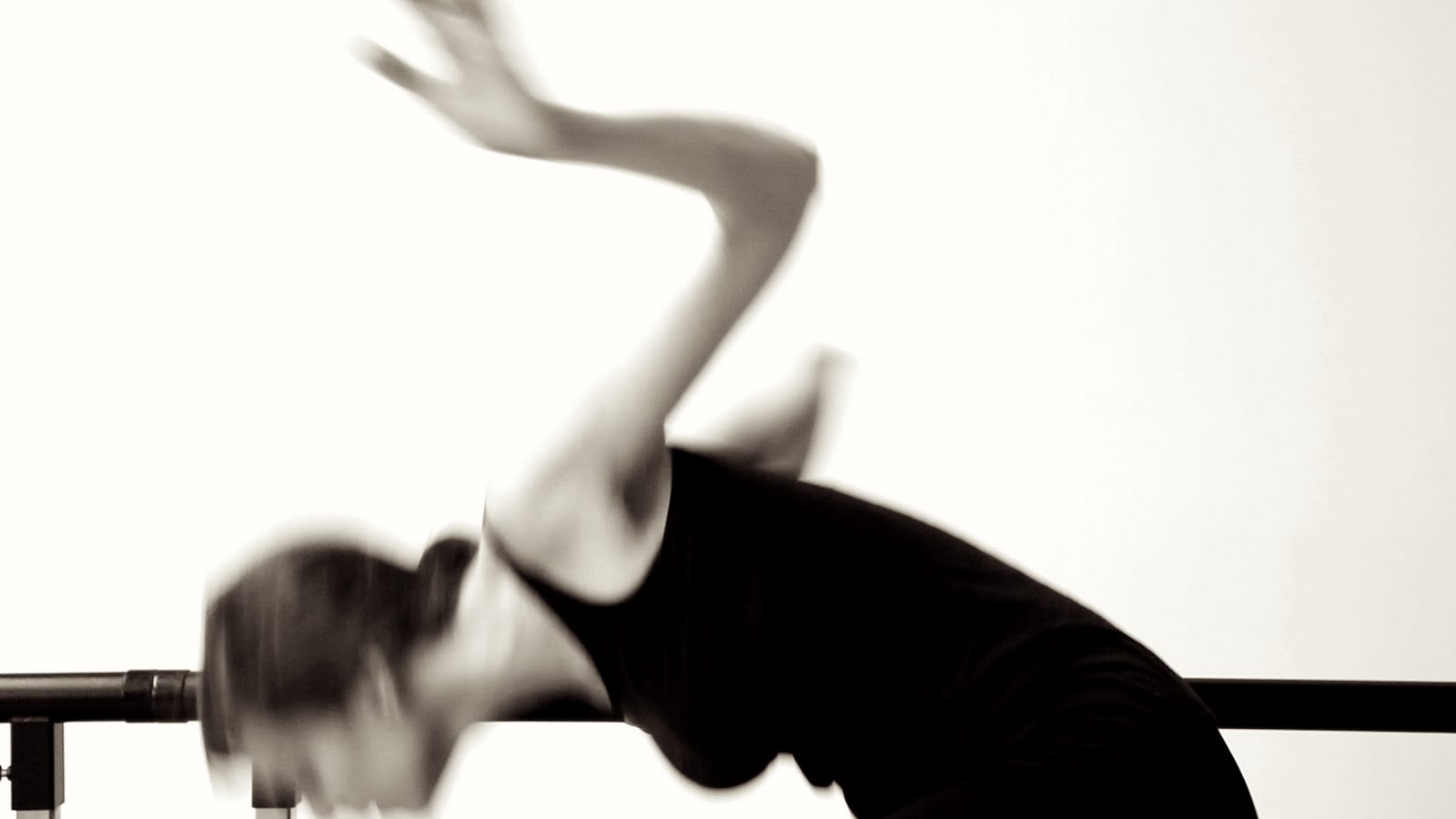
If a picture's worth a thousand words then The Visitant (as a spectacle of gesture) is priceless. It is extreme, it is powerful and despite some naff acting by the musician/composer Trevor Knight, it is good theatre. No words of criticism like that she's no singer(!) can lessen the impact of Aoine O'Dwyer's harp playing. She's superb on the instrument though admittedly she's no actress either. Indeed, as the narrative progressed both Aoine and Trevor became somewhat of an encumbrance on the stage, somewhat getting in the way of the true hero of the evening, the choreographer and Butoh dancer Gyohei Zaitsu.
The stage production however earns few brownie points in my book. Some significant action takes place on the floor which is hardly visible from anywhere bar the first two rows of the audience. At other times Aoine and Trevor block the view of the dancer completely. A surprising mistake on the director's part as this was essentially dance theatre with no spoken narrative to shift the audience focus and propel the story along.
The costumes were another curiosity. Compared to the rather exquisite attire of the dancer, Trevor sporting an off-the-peg if unusually colourful suit and Aoine's long dress did little for the play's aesthetic resolve.
As for the stage design, a few uncomfortable comments need to be made. Alice Maher is a good and well meaning artist and the ramp in the middle of the stage was a stroke of genius, I admit, but what of the rest? She should have known better. The stage is not a painter's canvass however tempting, nor is it a sculptor's pedestal to make a personal statement. Neither is it about decoration, however inventive. Stage design is architecture focused specifically on the dramatic narrative. The actors' play has a point and the designer's task is to materially extract from the story the elements that make it believable and to put these squarely before the audience. From a transient narrative to conjure up substance within the confines of the stage. In The Visitant however the final effect of the messy electronic paraphernalia higgledy-piggledy all over the place and the elephant of a harp smack in the middle of it all was rather more grating than surreal.
However, to be clear, the glory of the evening goes to Gyohei Zaitsu's performance and the music, both as composition and performance, and I feel immensely thankful for that.
Lighting Design Marcus Costello
Set Design Alice Maher
Costumes Yuni Hong
Production Management Miriam Duffy
Produced by Aisling Murray
Translate
Sunday, February 23, 2014
NEW MOVEMENTS: REBECCA REILLY at Dancehouse, Dublin. 17th January 2014
Choreography Rebecca Reilly
Performers Trevor Furlong, Leoba Petrie, Tonnta Choir, Katherine O' Malley, Philip Connaughton and Fergus Byrne
Performers Trevor Furlong, Leoba Petrie, Tonnta Choir, Katherine O' Malley, Philip Connaughton and Fergus Byrne
Although still a work in progress, this was a spectacular showing of an intense melange of sound design (Trevor Furlong), the cello (Leoba Petrie) and the voice by the members of the Tonnta Choir. Unfortunately the dance did not amount to much. Admittedly, in the context of such talent the choreographer might have felt it'll do but really, isn't a research bursary about raising the bar and living up to the challenge?
I suspect the problem may stem from the multiplication of roles that a choreographer is expected to fulfil these days. Apart from creating the dance narrative itself, choreographers are stage and production designers, accountants and producers, and whatever else that falls their way. I don't pretend to have an answer but I feel that a broader involvement of drama and theatre talent in dance, along the lines of creative collaborations already established with musicians, filmmakers and the like, might not be a bad idea.
I suspect the problem may stem from the multiplication of roles that a choreographer is expected to fulfil these days. Apart from creating the dance narrative itself, choreographers are stage and production designers, accountants and producers, and whatever else that falls their way. I don't pretend to have an answer but I feel that a broader involvement of drama and theatre talent in dance, along the lines of creative collaborations already established with musicians, filmmakers and the like, might not be a bad idea.
Sunday, January 5, 2014
ROAD MOVIES
Road Movies
A friend of mine suggested I watch some Irish movies as homework before I say more on the subject. So for anyone interested here goes. My aim is a film maker's analysis rather than a review of any of the films. The difference is like that in all art and wine. Bad may still be worth consuming and give pleasure though in the end you're hardly better off.
Now, this will only make sense to those who have seen the film when I say that “I Went Down" was finally a disappointment. The main character was underplayed throughout, close on boring in fact while his accomplice was actually very funny and kind of grew on you. It's like the director or the writer or whoever could not make up their minds as to who the hero was meant to be . . It rather reminded me of “Sideways” where for about a third of the film the hero’s travelling companion takes the central spot. It is subtle and you only realise it when you begin to feel more for the secondary character than the hero. Admittedly the film recovers but only with some heavy footed emotional pounding the hero gets from his ex-wife at his friend’s wedding.
The pivotal point in “I Went Down” when the cheerful accomplice saves the hero's life lacked focus. A shame as it was critical to the plot when from unwilling bed fellows they become friends of sorts. The drama was lessened again when the guy they had kidnapped to bring back to the bad boss revealed himself a far more interesting figure than our hero.
All in all, the plot was too complex to follow or care. The shoot-out scene at the end was slow in coming not to mention that the main villain was so unbelievable. He had the lines, he just about had the face but the body language was totally unconvincing. It made you think, this guy is scaring them? Really? Also, the love interest was underdeveloped to make much sense. As a character the ex-girlfriend was a non-entity. It seemed rather like a stab at padding out. At least she could have been a manipulative bitch who wants more than she deserves or gets. It may be unwarranted to put it all down to bad direction but clearly something's gone wrong.
The camera work was often clever without a good reason which is always a no-no. This is where American cinema excels. Never a self conscious shot. The camera is there to serve the storyline. It is a guide to bring us along and show us whatever it is that we are told. That said, it was still far more intelligent than in "The Eclipse" but that is another story
Friday, January 3, 2014
JAMES JOYCE’S DUBLIN. VINTAGE PHOTOS FROM 1897 TO 1904
JAMES JOYCE'S DUBLIN
"Had the real Dublin crumbled . . "? Unfortunately in a very substantial sense the real Dublin has crumbled. Only a short hop to the An Taisce offices or The Georgian Society website will show you the extent of it. Though it is local mess, it continues to shape the nation's image of itself. This is tragic for there are good many people here - remember the thousands that demonstrated against the Wood Quay development? - but the prevailing political ethos is far below this country's best. The peculiar pandering to the lowest common denominator encapsulated so well in the "Sure, it'll do" mentality does no one any favours here.
"Had the real Dublin crumbled . . "? Unfortunately in a very substantial sense the real Dublin has crumbled. Only a short hop to the An Taisce offices or The Georgian Society website will show you the extent of it. Though it is local mess, it continues to shape the nation's image of itself. This is tragic for there are good many people here - remember the thousands that demonstrated against the Wood Quay development? - but the prevailing political ethos is far below this country's best. The peculiar pandering to the lowest common denominator encapsulated so well in the "Sure, it'll do" mentality does no one any favours here.
IRISH FILM
Irish Film
Image and dialogue are mainly functional categories in film. Useful in direction and production though far less so in screen writing. In other words a film or a play are experienced as a series of actions. There's a great book on this, "Backwards and Forwards" by David Ball. I have a feeling that what some might mean by undue focus on image in Irish film is really quite a recent phenomenon in film in general that came with all the advances in image acquisition and processing technologies. It's only understandable. It was the same with CinemaScope as it is now with 3D. Just look at a Polish disaster of a 3D film "Battle for Warsaw 1920”. It will all pass. In the meantime here are a few thoughts on Irish film in general.
Lack of, a dearth of tragedy. Like everyone knows, the main thing about tragedy is that the hero struggles against all odds for what is believably presented to us as a laudable goal. In true tragedy (and these days very little of it about) the hero's suffering is inflicted upon her or him wantonly. It is a Greek invention. It asserts the basically unreasonable nature of the course of History. This is what makes the Hero's actions heroic, it is a fight for a (generally assumed) Lost Cause. The Hollywood Happy Ending is a clever adaptation of this by making, equally unreasonably, the Good and the Happy triumph. A good book in this context is "The Death of Tragedy" by George Steiner. An example of a film that should perhaps have grasped this tragic mantle is "What Richard Did". I admit I never read the book on which the film is based but if Richard is a hero then we do need to see him far more as an individual with a unique goal and which Gods (and why) decreed his tragic fate.
Local nature of Irish film is a common issue. Often a way out is to focus of the mechanics of the story, the plot itself, see the successful British "Lock, Stock and Two Smoking Barrels". Another approach is to universalise the human condition eg. "The King's Speech". Another angle that has worked well in "Once" for example is to make the story cross cultural.
Monday, December 9, 2013
DEPARTURES at The Riley Theatre, NSCD. 7th December 2013
O Maria
Performers Sabrina Ribes Bonet, Victoria de Silva and Joao Maio
Choreography Carlos Pons Guerra
O Maria was an impressive piece of dance theatre. Perhaps not the most subtle in its symbolism, nonetheless it rose far above the usual cultural stereotypes. Whether Seville under Franco's regime had really anything to do with the story or the fact that the sado-masochism was conspicuously in kid's gloves, what to me was most impressive was the way the show handled nudity and it's transgender leitmotif. The erotic narrative had both precision and panache especially in Sabrina Ribes Bonet performance. Victoria de Silva's character could have done with less hip swaying perhaps but her dancing had a bold aesthetic integrity and Joao Maio brought out flawlessly the comic aspect of the Male Mary.
I Entity
Performer Elisabetta d'Aloia
Choreography Riccardo Meneghini
I Entity begins well. A woman, a blond wig on her foot, stares at it like at another's face. A magic mirror, her alter ego perhaps? Questions and expectations arise. What does she see? How does she feel? What will she do? Soon however, trousers off, boots and the blond wig on, away she goes. What began so well theatrically unravels into a less than choreographed solo. Elisabetta d'Aloia is a dancer with a poetic presence that might need a stronger dramatic structure to come into her own.
Life is a Carnival
Performer and Choreography Moreno Solinas
Moreno Solinas is a young Olympian with a taste for the tragic, the offbeat and the surreal. The recipe may not have worked as expected on the night but the intention was clear. From the smallest of finger movements to the whole body as nature intended, Life is a Carnival was one consummate piece of method acting. The blend of Fado like singing and detailed, masterly controlled movement with just a hint of Buster Keaton mad-hatter daring created a spell binding dance narrative. Transparent without simplification, solemn and comic, Moreno's confident handling of the dramatic structure was dance theatre of the first order.
Missing
Performers Ruth Janssen and Riccardo Meneghini
Choreography Douglas Thorpe
Mad Dogs Dance Theatre
Ruth Janssen and Riccardo Meneghini are both experienced dancers but Missing landed far from its avowed aim. Admittedly, it was an ambitious undertaking. A couple's breakdown of intimacy after the loss of their child is often a closed circle of pain and hard to communicate. In this instance however, the choreography was vapid and too cliched to be emotionally engaging and the dried leaves underfoot as a natural symbol of death were more of an encumbrance than an integral part of the spectacle. The sense of ghostly emptiness that comes with the rustle of leaves in silence would have gone some way towards establishing a meaningful core of the piece on stage. Alas, Missing was an artistic challenge which needed far more of one's creative best thrown at it than I feel was the case on the night.
Abba, Pastries and the Stiff Upper Lip
Performers Rachel Fullegar, Sarah-Maria Cook, Rebecca Holmberg, Kate Cox.
Choreography Gracefool Collective
I admit I'm not a fan of dancers speaking, we do have actors for that, but the cabaret like Abba, Pastries and the Stiff Upper Lip was fun. The dolly dolls and the moustached narrator in laced culottes gave a confident account of their talents in this Benny Hill type sketch. Though as the basis of the dramatic narrative, the Englishman, the Swede and the Dane joke did not seem to resolve itself, the performances were accomplished and the choreography well defined and tight.
Tuesday, April 24, 2012
FRAME ARCHITECTURE DANCE FILM
FRAME ARCHITECTURE DANCE FILM
Friday 27 April 2012 at 7:30pm
Saturday 28 April 2012 at 7:30pm
OLD PATHOLOGY LAB
NATIONAL CONCERT HALL
EARLSFORT TERRACE, DUBLIN 2.
Friday 27 April 2012 at 7:30pm
Saturday 28 April 2012 at 7:30pm
OLD PATHOLOGY LAB
NATIONAL CONCERT HALL
EARLSFORT TERRACE, DUBLIN 2.
Created and performed by Michelle Fagan and Ríonach Ní Néill
Original Music by Pierecall
Production and Lighting Design Kevin Smith
Produced by Richard Wakely

FRAME at BLACK BOX, Galway photo: Marek Bogacki

FRAME at BLACK BOX, Galway photo: Marek Bogacki

FRAME at BLACK BOX, Galway photo: Marek Bogacki
FRAME is a site specific dance production created and performed by Michelle Fagan and Ríonach Ní Néill with film works by Marek Bogacki. The producer for Frame is Richard Wakely. In this new work, multi-award winning architect Michelle Fagan (FKL Architects), choreographer Ríonach Ní Néill and film-maker Marek Bogacki explore the architectural imagination and creative process, reflecting on our experience of the built environment as something made as much of ideas and emotions as of material.
BLACK BOXFRAME is a site specific dance production created and performed by Michelle Fagan and Ríonach Ní Néill with film works by Marek Bogacki. The producer for Frame is Richard Wakely. In this new work, multi-award winning architect Michelle Fagan (FKL Architects), choreographer Ríonach Ní Néill and film-maker Marek Bogacki explore the architectural imagination and creative process, reflecting on our experience of the built environment as something made as much of ideas and emotions as of material.
The production is funded by the Arts Council and the Department of the Environment, Heritage and Local Government under the Engaging with Architecture Scheme with support from a range of partners including Project Arts Centre, Dublin; the Office of Public Works; the Architectural Association of Ireland; National Concert Hall; the Irish Architecture Foundation and the Royal Institute of the Architects of Ireland.
Ciotóg’s Artistic Director, Ríonach Ní Néill, is Galway Dancer in Residence and a member of the Project Arts Centre’s Catalyst Programme. Michelle Fagan is the current President of the Royal Institute of the Architects of Ireland and Director of FKL Architects. Marek Bogacki is a Polish film maker and director. Richard Wakely is an independent theatre and dance producer and arts consultant who also produces for Junk Ensemble and Sol Picó Dance Company.
FRAME ARCHITECTURE DANCE FILM
Thursday 19 April 2012 at 8 pm
FRAME ARCHITECTURE DANCE FILM
Thursday 19 April 2012 at 8 pm
GALWAY

Saturday, February 12, 2011
PAPER PYLONS
PAPER PYLONS
21st - 26th February 2011 at 1pm
WOOD QUAY VENUE21st - 26th February 2011 at 1pm
DUBLIN CITY COUNCIL CIVIC OFFICES
Choreography and Artistic Direction: Fiona Quilligan
Dancers: Olwen Grindley, Fiona Quilligan and Maria Nilsson
Film Direction: Marek Bogacki
Photography: Marcelo Biglia
Music: Jack Quilligan
Lighting Design: Kevin Smith

PAPER PYLONS photo: Marcelo Biglia
Choreographer Fiona Quilligan and film maker Marek Bogacki explore archival material of the Ardnacrusha Shannon Scheme and create a work that reflects the scale and innovation of the project. The dancers bring to light Paper Pylons in a series of movements, film imagery and spoken word.
"The work stems from an early memory. My father catches me running out the door 'Fiona will you roll a few sticks for the fire'. He would often talk to me about his first job as a young engineer on the Shannon hydro-electric scheme in 1925 at Ardnacrusha, Co.Clare. He described the massive scale of the operation, Siemens the contractors, the size of the turbines with hundreds of rivets hammered in by hand. Listening to his voice I imagined the men working on the spiral casings as I rolled the paper.
PAPER PYLONS was made possible with the generous support of the Arts Council of Ireland.
HERON
HERON
Dancer: Maria Nilsson
Choreography Writer: Fiona Quilligan
Choreography Writer: Fiona Quilligan
Photography: Marcelo Biglia
Music: Fabio Keiner
Direction and Edit: Marek Bogacki
Produced by: DOCUMENTAVI 2011



Monday, January 31, 2011
PATRICK PYE COMMUNICATING EXPERIENCE
PATRICK PYE COMMUNICATING EXPERIENCE
A fragment of a talk by the painter Patrick Pye at the International Society of Christian Artists Conference at Glenstal Abbey, Co. Limerick, Ireland on 18th July 2009.
Friday, November 5, 2010
PAPER PYLONS INNOVATION DUBLIN 2010
PAPER PYLONS INNOVATION DUBLIN 2010
Wednesday 10th and Friday 12th November 2010 at 6pm
WOOD QUAY VENUEWednesday 10th and Friday 12th November 2010 at 6pm
DUBLIN CITY COUNCIL CIVIC OFFICES
Choreography and Artistic Direction: Fiona Quilligan
Dancers: Olwen Grindley, Fiona Quilligan and Maria Nilsson
Film Direction: Marek Bogacki
Photography: Marcelo Biglia
Music: Jack Quilligan
Lighting Design: Kevin Smith
As part of Innovation Dublin this dance performance and a film presentation demonstrate the research process of choreographer Fiona Quilligan in collaboration with film maker Marek Bogacki. Together they explore archive material of the ESB Shannon Scheme and create a work that reflects the scale, innovation and infrastructure of the project. An imaginative work that brings to light Paper Pylons and layered dance sequences and spoken texts.

Paper Pylons photo: Marek Bogacki

Fiona Quilligan and Olwen Grindley photo: Marcelo Biglia

Olwen Grindley photo: Marcelo Biglia
Tuesday, November 4, 2008
SEAMUS HEANEY THE POETRY OF ZBIGNIEW HERBERT
SEAMUS HEANEY THE POETRY OF ZBIGNIEW HERBERT
16th October 2008
IRISH WRITERS' CENTRE
16th October 2008
IRISH WRITERS' CENTRE
Tuesday, October 28, 2008
MARTIN REYNOLDS A GLIMPSE OF POLAND
MARTIN REYNOLDS A GLIMPSE OF POLAND
An interview with the architect Martin Reynolds about his exhibition of drawings of Polish civic architecture at Irish Polish Society Dublin in 2008.
Tuesday, April 15, 2008
PATRICK PYE ON ART AND CHRISTIANITY
An autobiographical talk by the painter Patrick Pye. It was recorded at the Church of St. Teresa, Clarendon St., Dublin, in 2007.
Wednesday, April 9, 2008
NEUROESTHETICS
Some time ago I came across an essay by V.S. Ramachandran and W. Hirstein on the neurology of artistic experience, and although it seemed to me badly mistaken I was hoping that someone else would answer it before I got round to it. John Hyman did, and very well too.
Ramachandran V. S. and Hirstein W. (1999). The science of art: A neurological theory of aesthetic experience.
John Hyman "Art and neuroscience", reprinted in Beyond Mimesis and Convention, ed. R.P. Frigg and M. Hunter, Boston Studies in the Philosophy of Science, 262, Springer 2010. (German translation in Kunst und Kognition, ed. M. Bauer et al, Wilhelm Fink Verlag, 2006; Greek translation in Neuroestética, ed. Antonio Martín Araguz, 2011.)
Download in .pdf format
You will find a recent review of this issue on SAGE OPEN by Jason Holt "Neuroaesthetics and Philosophy", also in Journal of Consciousness Studies, 6(6-7), 15-51.
Download in .pdf format
You will find a recent review of this issue on SAGE OPEN by Jason Holt "Neuroaesthetics and Philosophy", also in Journal of Consciousness Studies, 6(6-7), 15-51.
Download in .pdf format
Subscribe to:
Posts (Atom)